In November 2025 we invited placement student Naomi to respond to an object of her choice in our current exhibition 'Joyce Butler: The National Woman's MP'. Her choice of object - a newspaper headline from the late 1960s - provides a fascinating insight into the intersections between the cosmetics industry and women's health. Read Naomi's words below.

‘WHAT’S IN A KISS? QUESTION FOR MPs’ is an eye-catching newspaper headline in the Joyce Butler exhibit at Bruce Castle.
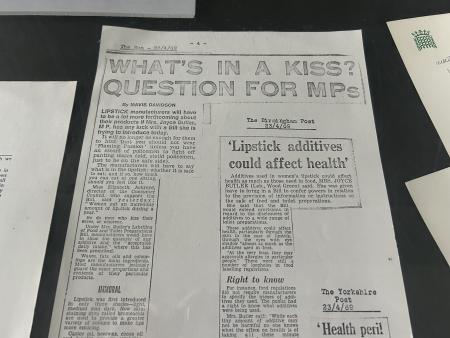
The headline is referring to Joyce Butler’s campaign for the ‘Labelling of Food Bill’ in 1965 to 1969. Butler first introduced the ‘Labelling of Food Bill’ in 1965, and her campaigning saw the government introduced food labelling regulations and the Trade Descriptions Act. However, in 1969 Butler reintroduced the act to parliament believing more needed to be done.
The Labelling of Food and Toilet Preparation Bill had a strong focus on cosmetics and toiletries and the additives within them. Joyce Butler calls for companies having to list the amount of additives added into their products, arguing that consumers have the right to know. The Bill sparked many headlines mostly concerning additives in lipstick.

What is interesting about this Bill, and subsequent news articles, is that it reveals the sexist beliefs around the cosmetics industry and that a lack of industry regulations was linked to the fact cosmetics were seen as being 'for women'. In her speech Joyce Butler attempts to appeal the importance of the bill by reminding any honourable Gentleman who feels ‘superior about the vanity of women’ how the male cosmetics is a big industry and how ‘sales are booming.’ This suggests how Joyce Butler needed to state how her bill was also impactful for men in order for it be seen as important and worth parliament’s consideration.
This need to include men is continued in the newspaper articles, with The Sun reminding readers it is not just women who eat a lot of lipstick but also ‘men who kiss their wives or whoever.’ This lack of concern for women’s heath (until it affects men) is something that Joyce Butler fought against fiercely throughout her career especially with her campaigning over cervical screening.
The sexism around the cosmetics industry is seen in the language used by Joyce Butler and newspapers. Women’s cosmetics is about ‘vanity,’ whereas for men it is simply just cosmetics. There is a strong feeling that Joyce Butler had to use somewhat sexist language in order succeed in the male dominated parliament (perhaps a 1960s example of the current TikTok trend ‘#Womeninmalefields’). The Suns references to wearing lipstick causing women to have to fight off ‘panting men,’ and immorality of lipstick before World War One is suggestive that make-up could draw unwanted attention or was seen by men as being wore for them.
The Labelling of Food and Toilet Preparation Bill and its subsequent newspapers give us an insight into how Joyce Bulter battle sexism and 1960s sexism in general.