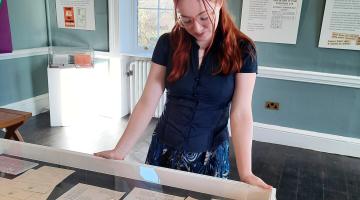
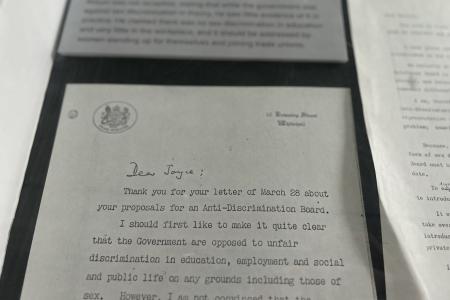
In November 2025 we invited placement student Isobel to respond to an object of her choice in our current exhibition 'Joyce Butler: The National Woman's MP'. Her choice of object - a letter from Prime Minister Harold Wilson to Joyce Butler - provides crucial context for the struggle to secure Equal Rights for Women the UK. Read Isobel's words below.
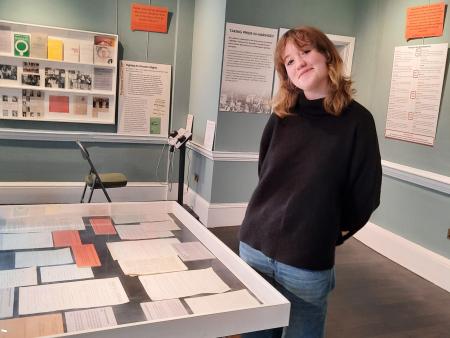
2025 marks the 50th anniversary of the implementation of the Sex Discrimination Act. Rarely acknowledged however, is the efforts of Joyce Butler in providing the foundations for this landmark bill.
In the exhibition there is fascinating correspondence between Joyce Butler and Prime Minister Harold Wilson on the issue of sex discrimination. Their conflicting views on the matter encapsulate the division between the supposed progressive nature of the 1960s and the deep-rooted sexism it was struggling to shake off.
Butler’s activism, in the absence of Wilson’s support, makes her plight all the more pioneering. Her progressive advocacy for women on a local and national level, cements her legacy as vital in women’s rights history.
Speaking in 1965, Butler condemns the fact that:
“women are taken so much for granted in the background: society does not see women enough as people who do things”.
In March 1968, sparked by a woman being prevented from becoming a bus inspector on the grounds of her gender; Joyce wrote the letter to Prime Minister Harold Wilson, now seen in the exhibition, proposing a board to specifically tackle sex discrimination, like that of the Race Relations Board.
Wilson, disappointingly, was unreceptive to Butler’s cause as he saw little evidence for sex discrimination either in education or the workplace. The acceptance of anti- sex discrimination in theory, but its denial in practice highlights the entrenched obstacles for women’s rights at this time.
Her criticism of the dim prospects of women in society echo calls from other MPs like the incumbent Secretary of State for Employment Barbara Castle. In the year of the 50th anniversary of women’s suffrage - Butler’s bill gained significant cross-party support, as catalytic groups like the Women’s Liberation Movement agreed with Joyce’s view that women are “fed up” with substitutions for “equal human rights”.
Despite strong momentum, it took another 7 years from Joyce’s letter to Harold Wilson for the Sex Discrimination Bill to be ratified. Even then, many jobs classified as ‘women’s job’s’ were left out of the scope of equal pay and the fight for equality continues today.
In this 50th anniversary year, the importance of Joyce’s activism is perhaps greater than ever. Her words from 1973 endure:
“No bill is a cure all. One makes a step forward and realises just how much more there is to do”.