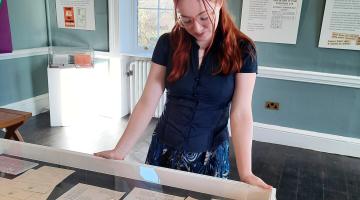
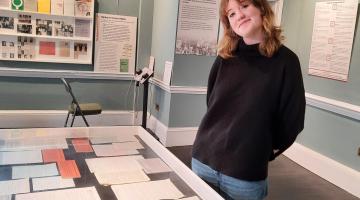
As a part of the UNIQ+ internship programme run by the University of Oxford, I was invited to visit the Bruce Castle Museum and Archive in London, along with my fellow interns. We were given a tour of the archives and Dr Lyndsey Jenkins showed us around an exhibition she curated on the MP Joyce Butler as part of a wider project she is working on.
Joyce Butler – Social Justice and Women’s Rights
Dr Jenkins’ exhibition explores Butler’s role in various campaigns, from healthcare and social issues to women’s rights, it shows how Butler contributed to the passing of the 1975 Sex Discrimination Act, and how she advocated for healthcare generally.
The first thing I was drawn to in the room was the section covering Butler’s campaign for cervical cancer screening. The colourful display shows a range of leaflets from mid-twentieth century campaigns right up to present day booklets you would find at the GP. Not only was this very eye-catching, but it was a striking reminder of how these issues remain relevant to this day.
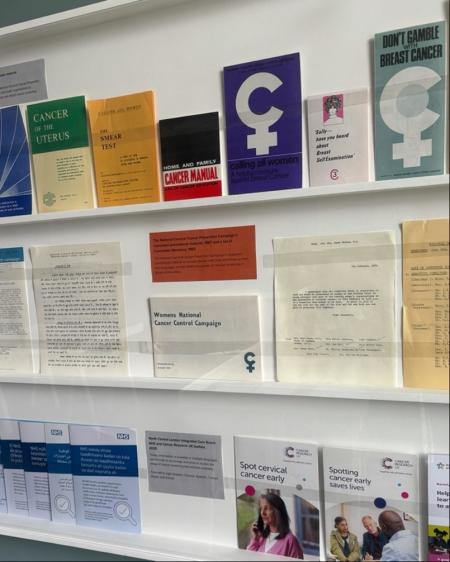
When Dr Jenkins spoke about the curation process, this idea of connecting history to the present came up once again. She described her exhibition on Butler as a “history in progress” – the exhibition is not the end point, nor a static moment in time, but rather follows narratives which continue into our present. I find history is often thought of as some distant time and place, entirely removed from the current day, but we of course exist in relation to the histories we study. Looking at the arrangement of medical leaflets, I realised how those leaflets contemporary to myself would soon become another moment in history viewed by posterity.
Getting some insight into the curation process also made me think about the idea of the exhibition space itself, considering the journey people go on as they walk through the space. I realised how intentional every aspect of curation is. What is the first thing you should see as you walk in? How should artefacts be spread out across the room to present the narrative? What themes and questions do you want to present to the viewer? Dr Jenkins also spoke about the challenges involved in visually displaying print materials like letters, in an engaging way. As someone who loves to visit museums and different exhibitions, I gained a greater appreciation for how much effort goes into every part of the process, beyond just the content displayed.
Queer Protest and Rights
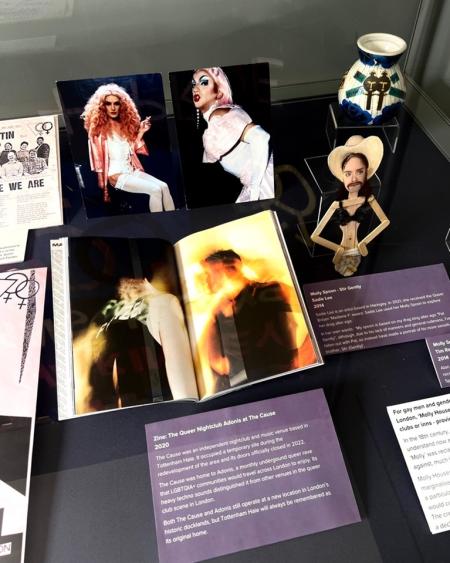
In another smaller room within the Museum was an exhibition on queer history, documenting queer protest, activism, and community in the borough of Haringey. One visual particularly stood out to me – a poster publicising a 1987 demonstration by Haringey Black Action and Positive Images. The poster reads ‘Black Lesbians & Gays Fight Back!’ and ‘Asian Gays are Out and Proud!’. Through the placards I read about how local communities organised and resisted against both racist and homophobic discrimination, in connected and tactful ways.
As I walked through the room, I wondered why I had not heard of this protest before my visit to Bruce Castle; I realised that my knowledge of queer resistance had mostly been informed by the more well-documented protests in central London. This exhibition cemented for me the importance of challenging ideas of ‘big’ history to recognise the contributions of lesser-known protests and actors within this. I especially enjoyed seeing the many layers of resistance and how it ranged from explicit public protests to the simple act of being visible as a queer individual.
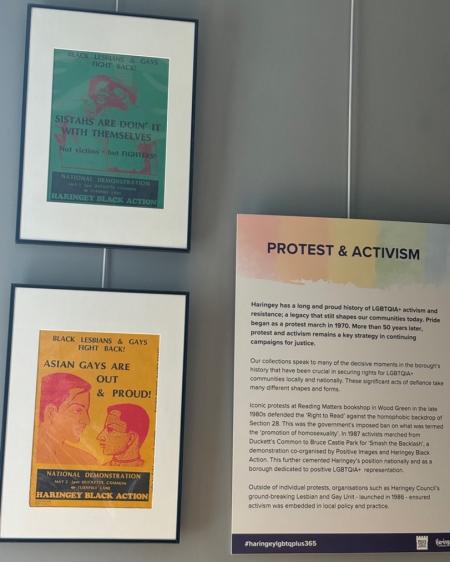
It was very meaningful seeing this intersection between these different types of underrepresented histories – that of marginalised groups, and of a less documented local history. Displaying the contributions of POC queer people specifically was also very impactful, particularly as a group that continues to be underrepresented in discussions of queer rights.
In a display case next to the poster was a zine about a queer nightclub in Tottenham Hale and how it fostered a sense of community for LGBTQ+ people across London. While knowing that queer spaces are often subversive, challenging ‘traditional’ roles and structures, I was still quite surprised to see a nightclub documented within an exhibition. I am very keen to use non-traditional sources in the study of history and this display made me further question and expand my understanding of what we should document as historians. After walking through the queer history exhibition, I felt very moved seeing an exhibition capture how community operates on several levels and how identities overlap and intersect.
Exploring the Archives
Having undertaken my dissertation in intellectual history, consulting mostly theoretical and political texts available online, for the most part I had avoided a central experience of any historian – navigating physical archives. In many ways, my trip to Bruce Castle demystified this process for me. Invited to see the archives behind-the-scenes and the array of massive ledgers and boxes, this was a very lovely reminder of how our history exists not only in memory and lived experiences, but in the tangible physical space it takes up in the world.
Exploring the archives also raised many questions for me. Dr Jenkins mentioned how the materials on Joyce Butler had been practically untouched before she had looked through them. Similarly, during my tour of the archives, I found out that some materials are in Latin and so less is known about their content. Julie Melrose, the Bruce Castle archivist, mentioned how she and the other staff members are often quite excited when an academic comes in to use the archive as they can find out more about the materials under their care. This gap between archival resources being physically accessible but then ‘inaccessible’ for a lack of wider knowledge of their existence, or for lack of the skills to make use of them, was something I had not consciously considered. Knowing how invaluable archival materials are, I have been reflecting on these different barriers to access and questioning the ‘neutrality’ of archives themselves.
Overall, my visit to the Bruce Castle Museum and Archive was very insightful. Records and displays about local histories memorialise local communities, and the importance of these records cannot be overstated. Seeing histories you are more personally connected to and seeing your own “history in progress” is meaningful. Having grown up across North and North-West London myself, it reminded me of where I was from and the importance of local history. While on my journey home I found myself thinking of my first experience visiting a local museum - Brent Museum located within Willesden Green Library. After all this time I still feel connected to that area, despite it being one among many places I have lived.