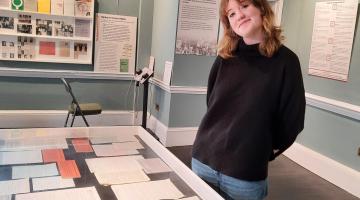
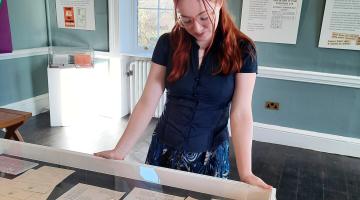
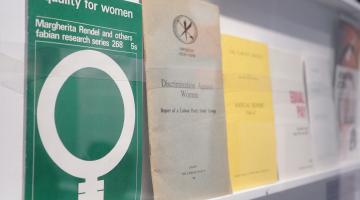
This summer I undertook a research internship at the University of Oxford. As part of the programme, a few interns and I were invited to Bruce Castle Museum and Archive in Haringey to view the exhibition “Joyce Butler: ‘The National Woman’s MP’”, created in partnership with Dr. Lyndsey Jenkins. This exhibition explores Butler’s wide ranging political activism in her time as a Councillor and MP for Wood Green.
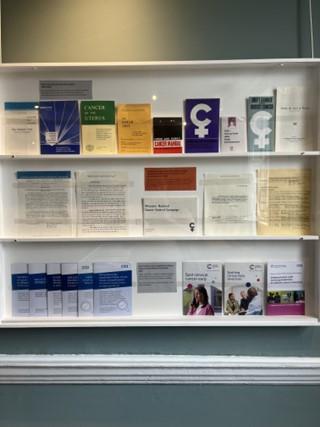
As someone who was previously unfamiliar with Butler’s work, I found the exhibition especially insightful as it highlighted her extensive impact on both the local and national level. Her notable role in the introduction of the Sex Discrimination Act 1975 is showcased; but the exhibition goes on to show her contribution to other issues varying from consumer rights to her work on making cervical cancer screening available.
It was the display regarding her work in cancer prevention campaigns which I found to be the most striking. Set out as a timeline, this features pamphlets spanning from twentieth century cancer prevention campaigns to NHS leaflets from 2025. This display prompted me to think about the process of curation and the importance of providing a link to the present, which is a clear and direct way of communicating Butler’s legacy and highlighting continuity.
Dr. Jenkins described this as a “history in progress.” The themes explored here, like cancer prevention and sex discrimination, are still very much relevant today. Illustrating the link to the present allows for a more engaging audience experience, allowing them to connect their lived experiences to the historical.
During our visit to Bruce Castle, we also had the opportunity to talk to Chlo Williams about the essential role of public outreach and engagement in exhibition curation. They emphasised how the curation process does not end once the exhibition opens – it is an ongoing process. The exhibition itself is not the finished product; deciding which communities and organisations to engage with and how to take the exhibition further is another aspect of the curation process.
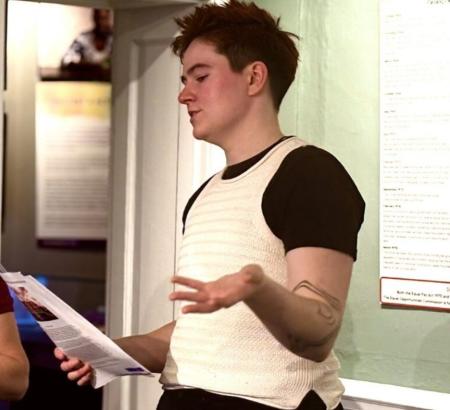
I had not considered this idea previously. It prompted me to reflect on the particular importance of public and community outreach in exhibitions which spotlight local histories. Through community outreach, local audiences can, through learning about the histories of local figures like Joyce Butler, build a personal connection to these figures, and thus history. Here, residents of Haringey can establish a link with Butler whose contributions, like instigating the Sex Discrimination Act 1975, left a lasting mark on history. On a collective level, engaging the public fosters a sense of community as audiences are able to build a connection based on shared history.
Public outreach is not a one-way street. Allowing visitors and audiences to share their own outlooks and feedback is a crucial aspect of public engagement. This fosters a conversation around the exhibition which includes and values public perspectives and input.
Overall, visiting the “Joyce Butler: ‘The National Woman’s MP’” exhibition was incredibly thought-provoking and enlightening. It was interesting to learn more about Joyce Butler who contributed to landmark cases and inform myself on the wide range of her activism and her continuing impact. By highlighting Butler’s legacy and through public outreach and creating dialogue, the exhibition ensures that history is not confined to the past but something that is “in progress”, to borrow Dr. Jenkins phrase, and a process that we are active in shaping. This reminded me of the importance of local history and, even more so, the need to engage with it. Engaging with local history is a way for us to connect to those who shaped our community and helps keep that history alive by recognising that it continues with us.